|
|
  
Search UNH Magazine: |
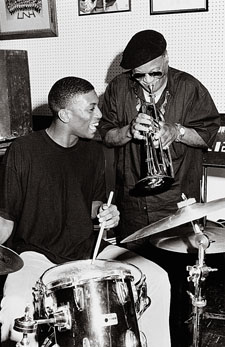
Hitting the High Notes Terry was introduced to jazz as a boy growing up in St. Louis, Mo., in the '20s and '30s. His older sister's husband played the tuba in one of the city's top bands, and sometimes he would let Terry come to the group's rehearsals. The boy particularly enjoyed watching and listening to one of the trumpet players. "Once he took a break, only to return to find me huffing and puffing on his horn," Terry recalled in an interview published in Jazz
Terry's professional career began in high school, when he played trumpet at a local bar, accompanying the piano player. He learned to play by ear and by watching more accomplished musicians. Fortunately, St. Louis had more than its share of good trumpet players, although some were none too eager to share their secrets. "Some we could ask questions of, but some we couldn't, because in those days the older players thought the younger players were trying to get in on their scene," Terry told journalist Steve Voce in another interview. "You remember, even Louis Armstrong back in those days used to keep a handkerchief over his fingers so the cats couldn't steal his tricks. "Fortunately, that attitude is really the opposite of the situation today. Those of us who are involved in jazz education feel that it's a very important thing to impart knowledge to young people. Many of the things that are involved can't possibly be documented, and if we go down with them, so go down most of the secrets." In the 1940s, Terry continued his jazz education during a stint in the Navy, playing in the Navy All Star Jazz Band. With his service completed, he played in the bands of Charlie Barnett, Charlie Ventura and Eddie Vinson before joining the Count Basie Orchestra in 1948. A few years later, he was recruited by Duke Ellington, for whom he was a featured soloist for almost 10 years. In an oft-quoted remembrance, Terry refers to that decade as an education at the "University of Ellington." In 1959, Terry left Ellington's big band to play in a small jazz group with Quincy Jones. Then, a year later, he settled in New York as a member of The Tonight Show Orchestra -- the first black musician on the NBC payroll. When The Tonight Show migrated to Los Angeles, Terry chose to stay in New York, where he had become one of the most sought-after studio musicians. "Clark is on everything," Seiler says of Terry's prolific recording work. "You name them, and Clark's played with them. I am always amazed to listen to a new piece of music and hear Clark. His sound is unmistakable." 
9 Edgewood Road Durham NH 03824 (603) 862-2040 alumni@unh.edu |